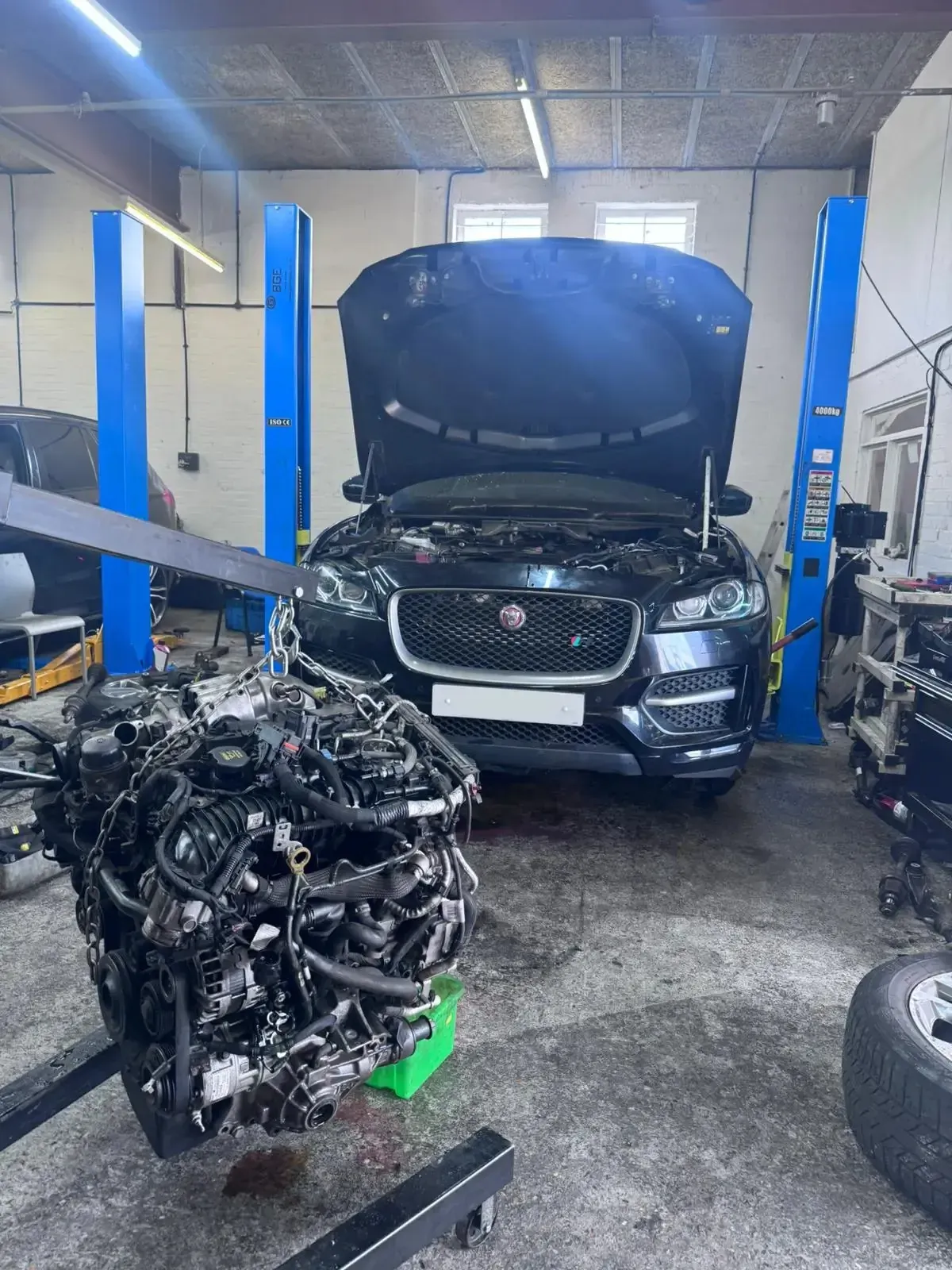
Short answer: Serious F-Pace SVR engine failures usually trace back to the cooling system or the timing drive of its 5.0 supercharged V8. Plastic coolant pipes under the supercharger and the water pump can leak and let the engine overheat, and the chain tensioners and guides can wear. A falling coolant level, a sweet smell after driving, a temperature warning or a rattle on start-up are the signs to act on straight away.
The F-Pace SVR is the fastest version of Jaguar's SUV. It uses the same 5.0-litre supercharged V8 family that powers the F-Type R, the Range Rover Sport SVR and the supercharged Range Rover. Wikipedia lists the SVR at 550 PS and 680 Nm from 2018, 700 Nm after the 2021 facelift, and 575 PS for the later SVR P575. It is a strong engine with a long history. It also has a small number of well-documented weak spots, and nearly every serious failure we are asked about starts at one of them.
What engine is in the Jaguar F-Pace SVR?
It is the AJ-V8 Gen III supercharged engine, often called the AJ133: a 5.0-litre, four-cam, 32-valve V8 with direct injection and an Eaton twin-vortex supercharger sitting in the vee between the cylinder banks. Four timing chains drive the camshafts: two primary chains from the crankshaft to intermediate sprockets, and two secondary chains from those sprockets to the camshafts. Jaguar Land Rover builds these V8s at its Engine Manufacturing Centre in Wolverhampton. Our 5.0 V8 supercharged engine page has the full specification and the list of models that use it.
Why do F-Pace SVR engines fail?
Few engines simply wear out. On this V8, the route to a failure tends to follow one of four paths.
1. Coolant loss and overheating
Coolant is carried between the cylinder heads by pipes in the valley under the supercharger, and on these engines several of those parts are plastic. Specialists including Stedmans and JLR Engines describe the pipes and the water pump as leak points that heat and age can crack. Because the valley is hidden under the supercharger, a slow leak can run for a while before anyone sees it. The level drops, the engine runs hotter, and an all-alloy V8 that overheats can warp its cylinder heads or fail a head gasket. Owners on the F-Pace forum report that metal replacement pipes have since become available, both from JLR parts and from aftermarket suppliers.
2. Timing chain tensioner and guide wear
JLR's bulletin LTB00474, reissued as version 2 in January 2015, told dealers to replace both pairs of chain tensioners and blades on this engine with revised parts. The new blades had a steel insert to resist wear, and the bulletin says an engine must not mix old and new parts. The F-Pace SVR arrived after that revision, but specialists still list tensioner and guide wear among this engine's faults. The warning is a rattle on start-up and, later, timing fault codes. If a chain is left to jump a tooth, the valves can hit the pistons.
3. Supercharger coupler rattle
A spring coupler, sometimes called the isolator, links the supercharger's drive to its rotors, and it wears. The result is a metallic rattle at idle, often most noticeable on start-up and shutdown. It is easy to mistake for timing chain noise, which is why it matters to diagnose it properly. Caught in time it is a much smaller job than a chain, but ignored for long it can damage the supercharger.
4. Oil supply problems
Low or degraded oil hurts every engine, but here it also affects the hydraulic chain tensioners. Coolant getting into the oil from a leak is especially damaging, because a milky emulsion cannot protect the crankshaft bearings. Change the oil to the grade and interval in the handbook. Check the level between services too, because a supercharged V8 that is driven hard can use some oil.
What are the warning signs of F-Pace SVR engine failure?
| What you notice | Most likely area | What to do |
|---|---|---|
| Coolant level dropping, no puddle under the car | Valley coolant pipes or water pump | Stop topping up and driving. Get it pressure-tested. |
| Sweet smell or wisps of steam after a drive | Coolant on hot engine parts | Check the level cold and book a diagnosis. |
| Temperature warning or gauge climbing | Coolant loss or a failing pump | Pull over safely and switch off. Do not drive on. |
| Rattle for a few seconds on a cold start | Chain tensioners or guides, or the supercharger coupler | Have the noise and the cam timing data checked. |
| Rattle at idle that fades with revs | Supercharger coupler | Book a diagnosis. Not usually urgent, but do not leave it. |
| Engine warning light with timing codes | Timing drive | Avoid hard driving until it has been checked. |
| Oil pressure warning or a knock from low down | Bearings | Stop the engine immediately. |
Is the Jaguar F-Pace SVR reliable?
There is no trustworthy published failure rate for the F-Pace SVR, and we will not invent one. What we can say is that its known issues are well understood, they are mostly maintenance-sensitive, and they give warning before they become terminal. An SVR with a steady coolant level, records of oil changes on time, a quiet cold start and evidence of cooling work is a different proposition from one with gaps in its history. If you are buying, a cold start and a pressure test of the cooling system are worth more than a long test drive.
How is an F-Pace SVR engine fault diagnosed?
A proper diagnosis keeps the expensive guesswork out of it. On an SVR we would normally work through these steps:
- Read the stored and pending fault codes with JLR-capable equipment, and look at live camshaft and crankshaft correlation data for signs of timing drift.
- Pressure-test the cooling system when the engine is cold, and run a combustion-gas test on the coolant to rule out a head gasket leak.
- Listen to a true cold start, and use a stethoscope to separate supercharger noise from timing noise.
- Check the oil for coolant contamination, fuel smell and metal, and cut open the filter if a bearing problem is suspected.
The result is a written report saying what has failed, what caused it and what the options are. That report is the basis of any quote, and it is useful evidence if a warranty or goodwill claim is possible.
Can a failed F-Pace SVR engine be repaired?
Usually, yes. What is needed depends on how far the damage has gone:
- Leak caught early: new coolant pipes, water pump and thermostat parts, with a cooling-system flush and pressure test. The engine itself is fine.
- Overheated: the heads come off to be checked for flatness and cracks. They are skimmed or replaced, with new head gaskets. See our head gasket repair service.
- Chain wear with no valve contact: a full set of chains, tensioners, guides and sprockets. See timing chain replacement.
- Chain jumped or bearings damaged: a strip-down and engine rebuild, or a reconditioned 5.0 V8 if the block or crank is beyond saving.
Our Jaguar F-Pace engine page covers every F-Pace engine, including the diesels and the four- and six-cylinder petrols.
How can I reduce the risk of engine failure on an SVR?
- Check the coolant level weekly when the engine is cold, and take any drop seriously.
- Let the engine warm up before using full throttle, and let it idle briefly after a hard run.
- Keep to the oil grade and interval in the handbook. Shorten the interval if the car does mostly short trips or track days.
- When the cooling system is opened for any reason, ask about upgrading the plastic pipes.
- Get any new start-up rattle diagnosed while it is still a noise.
F-Pace SVR losing coolant or rattling?
Send us your registration and describe the symptoms. We can collect the car, find the fault and quote for the repair or a 5.0 V8 rebuild, with collection and delivery within about 100 miles of the Rainham and Peterborough workshops. Engine work comes with 6 months with unlimited miles, or 12 months or 12,000 miles of warranty.
Get an SVR engine quote or call 020 8089 1373 / WhatsApp 07936 418074.
Frequently asked questions
What engine does the Jaguar F-Pace SVR use?
The 5.0-litre supercharged V8 from Jaguar's AJ-V8 Gen III family, often called the AJ133. It is rated at 550 PS, rising to 575 PS in the later SVR P575.
Why is my F-Pace SVR losing coolant with no visible leak?
Coolant from the pipes in the valley under the supercharger can collect out of sight or burn off hot engine parts before it reaches the ground. A cooling-system pressure test will find it.
Is a rattle on start-up a timing chain problem?
It can be, but on this engine the supercharger coupler also rattles, mainly at idle. The two need different repairs, so the noise should be diagnosed rather than guessed.
Can you drive an F-Pace SVR with low coolant?
Only to a safe place to stop. An overheating aluminium V8 can warp its heads or fail a head gasket quickly, which turns a pipe repair into an engine repair.
Is it worth rebuilding an F-Pace SVR engine?
In most cases, yes, because the rest of the car is usually sound and a rebuild deals with the original cause of the failure. We confirm what is needed after inspection and quote before any work starts.
Sources we checked
- Wikipedia, Jaguar F-Pace (SVR outputs and dates)
- Wikipedia, Jaguar AJ-V8 engine (Gen III, DI, TVS supercharger, Wolverhampton)
- JLR SSM71893 / TSB LTB00474 v2, AJ133 chain tensioner repair (via NHTSA)
- Stedmans, Jaguar engine problems (coupler, water pump and plastic coolant pipes, tensioners)
- JLR Engines, AJ133 supercharger coolant case study
- JLR Engines blog, Jaguar 5.0 supercharged V8 problems (primary and secondary chains)
- Jaguar F-Pace Forum, SVR coolant pipes upgrade thread (owner reports)
- JLR media technical data, F-Pace SVR 19MY and 21MY (logged in our spec-sources file)
More guides
 Engine Guides · 25 November 2026
Range Rover Classic and P38 Engine Rebuild: V8 and Diesel Guide
An owner guide to Range Rover Classic and P38 engines: Rover V8, 200Tdi and BMW diesel, common wear points and what a rebuild involves.
Read the guide →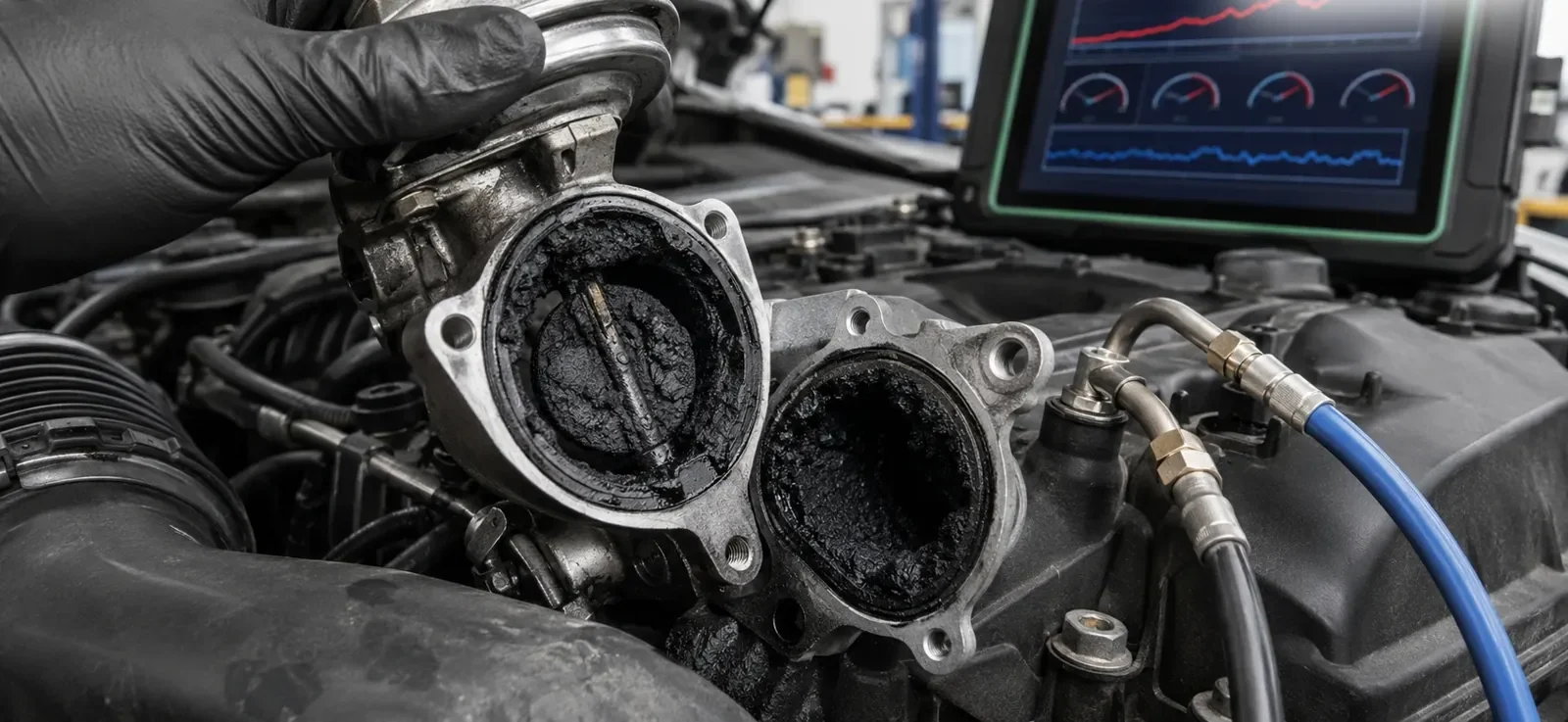 Owner Guides · 24 November 2026
Range Rover “Exhaust Filter Full” Warning: What It Means and How to Avoid Engine Damage
An amber exhaust filter warning is a request for a longer drive; a red one is not. Here is what each message means, how regeneration works and how a blocked filter can end up damaging the engine itself.
Read the guide → Engine Guides · 23 November 2026
Land Rover 200Tdi, Td5 and Discovery 2 Engine Rebuild Guide
An owner guide to rebuilding 200Tdi, 300Tdi, Td5 and Discovery 2 engines: common faults, what to check and what a rebuild covers.
Read the guide →