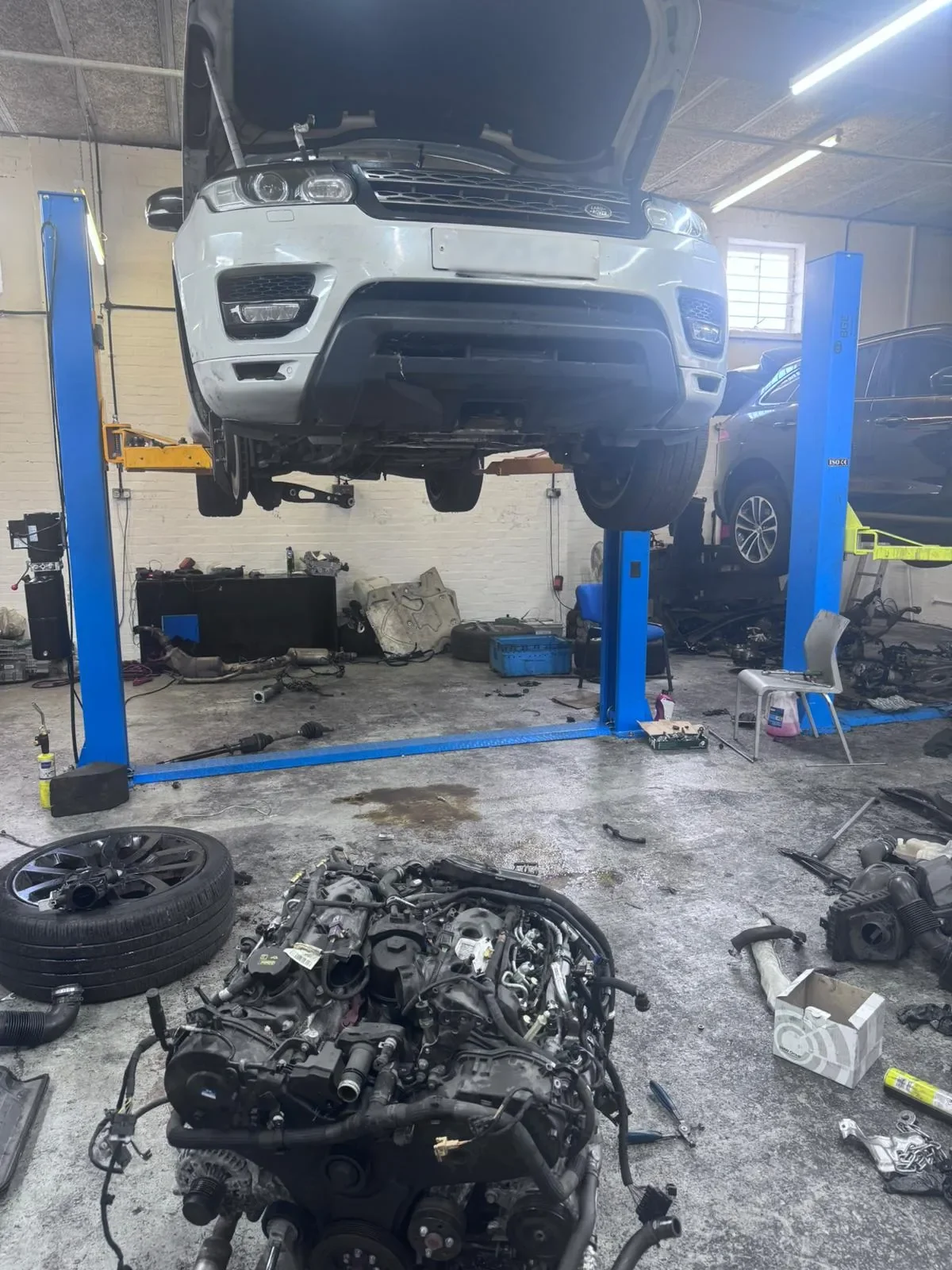
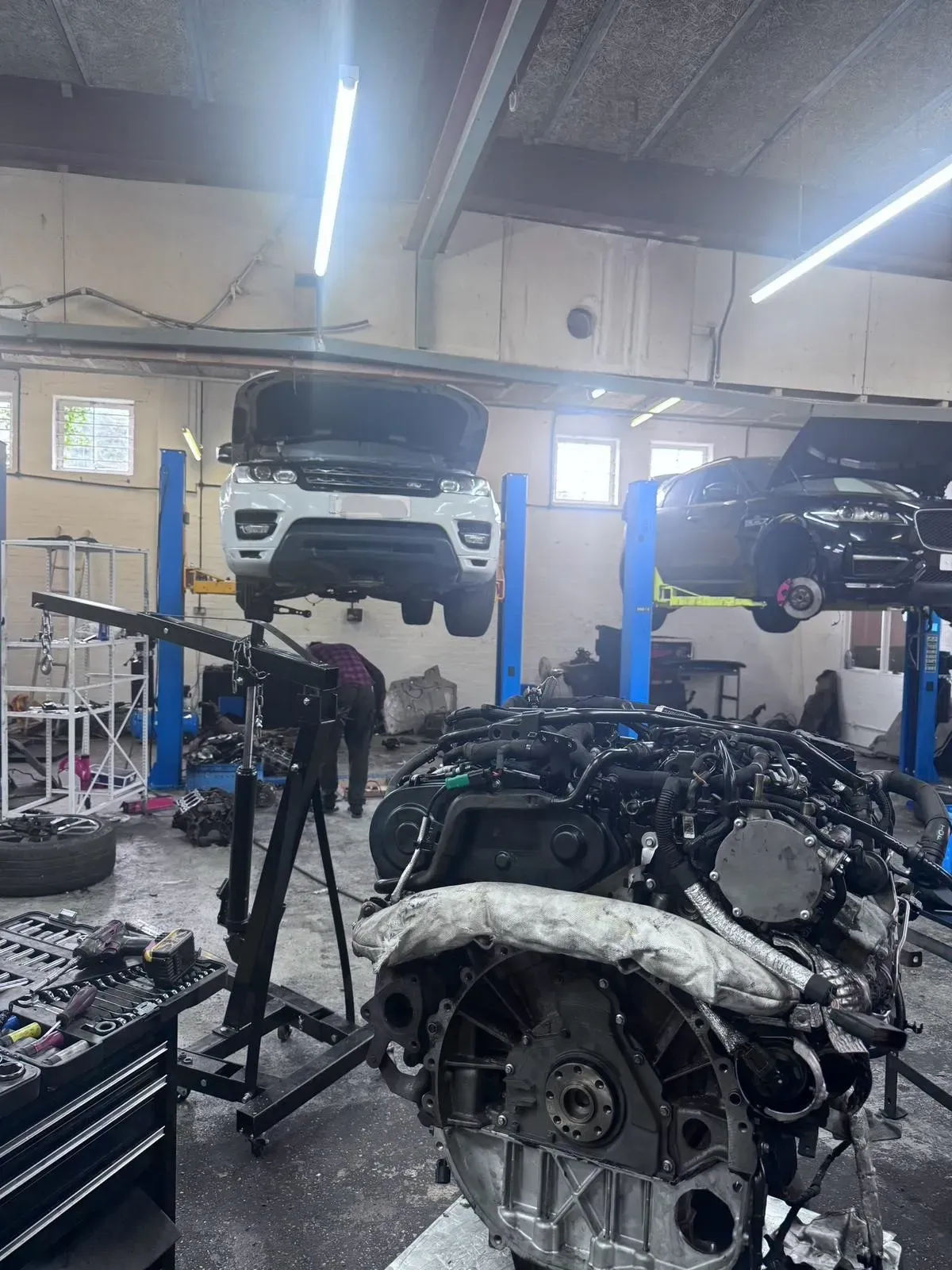
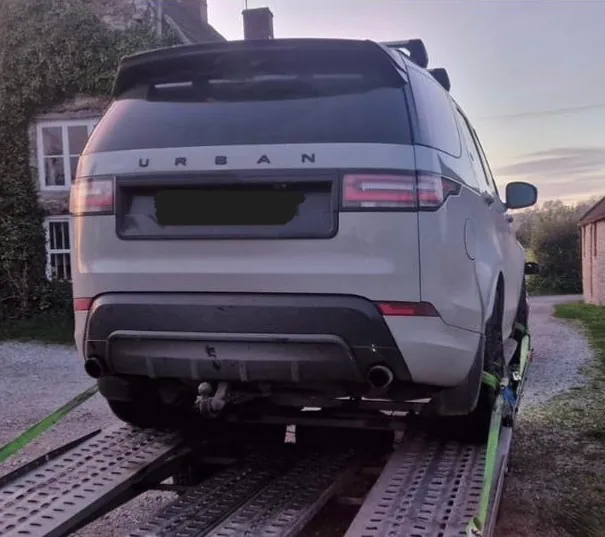
The 306DT is the 3.0-litre V6 twin-turbo diesel sold as the TDV6, SDV6 and Td6 in Land Rovers and Range Rovers, and as the 3.0d, 30d and D300 in Jaguars. We rebuild it in our own workshops, or supply and fit a reconditioned or checked replacement SDV6 engine, with your choice of warranty.
306DTTDV6SDV6Td6Jaguar 3.0d / 30dFord/PSA DT17 family
6 months unlimited miles, or 12 months / 12,000 milesRainham & PeterboroughCollection within about 100 miles
TDV6 or SDV6?Both are the 306DT. Send your reg and we confirm the output and year before we quote.
Overview & history
The 3.0 TDV6 / SDV6 engine explained
The 306DT was developed by Ford and PSA as part of the AJD-V6 / DT17 family. The 3.0-litre "Gen III" version replaced the 2.7 TDV6 and added a sequential twin-turbo system and an upgraded common-rail system with piezo injectors. Land Rover versions keep the 2.7's off-road adaptations, such as the large engine-driven cooling fan, and are calibrated to cope with lower-quality fuel.
JLR describes the engine as a longitudinal V6 with 24 valves and two-stage parallel-sequential turbocharging. The smaller turbo works on its own at low revs and the larger one joins in as revs rise, which is why the SDV6 pulls so strongly from low down. The block is compacted graphite iron.
Two things decide most 306DT jobs. The first is the bottom end: main and big-end bearing shells can lose their oil feed and turn in their housings, and the crankshaft is then damaged. The second is the timing belts. The camshafts are driven by a toothed belt at the front, and a second belt at the rear drives the high-pressure fuel pump. Both age with time as well as mileage. Each is covered below so you can match it to what your car is doing. Whether it sits in a Discovery 4, a Sport or a Range Rover, the job is the same, and both Range Rover engine rebuilds and Land Rover engine repairs cover it.
Technical data
3.0 TDV6 / SDV6 (306DT) specification
From JLR technical data sheets.
Item
306DT 3.0 V6 (TDV6 / SDV6)
2.7 TDV6 (276DT) for comparison
Displacement
2,993 cc
2,720 cc
Bore × stroke
84.0 × 90.0 mm
81 × 88 mm
Layout
60° V6, DOHC per bank, 4 valves per cylinder (24 valves)
60° V6, 24 valves
Compression ratio
16.1:1 (JLR 2013 Range Rover data; Wikipedia quotes 16.4:1)
17.3:1
Aspiration
Two-stage parallel-sequential twin turbo
Single variable-geometry turbo in Land Rovers
Injection
High-pressure common rail with piezo injectors
Common rail
Timing drive
Toothed cam belt at the front, toothed fuel-pump belt at the rear
Front cam belt and rear fuel-pump belt
Belt interval
Commonly quoted as 7 years or 112,000 miles, whichever comes first (check your handbook)
Commonly quoted as 7 years or 105,000 miles
Block
Compacted graphite iron (CGI)
Compacted graphite iron (CGI)
The 2.7 column is for reference. The 2.7 TDV6 (276DT) appears on this site only in 2010 model-year Discovery 4s; ask us about Discovery 3 and 2005–2009 Range Rover Sport 2.7s. Belt intervals vary by market and year, so always check your own handbook or service record.
Power outputs & badges
Which badge is which 306DT?
The badge on the tailgate tells you the output. The same 306DT has been sold at several outputs, and the figure changed with the model year.
The SDV6 Hybrid combined the 306DT with an electric motor in the gearbox. Early cars (2010–2011 model years) used a 245 PS version with a six-speed gearbox; the 211 PS and 256 PS versions with the eight-speed followed for 2012.
Vehicles fitted
Which cars use the 306DT engine?
Every V6 diesel Land Rover, Range Rover and Jaguar covered on this site, from the 2010 Discovery 4, Range Rover Sport L320 and Jaguar XF and XJ to the last Discovery 5 V6. It was replaced by the six-cylinder Ingenium 3.0 I6 diesel (AJ20D6) from around 2020/21.
A 2010 Discovery 4 3.0 TDV6, a 2012 Range Rover Sport SDV6, a 2018 Range Rover Sport SDV6 and a 2019 Velar D300 V6 are all the 306DT. Your registration is enough for us to confirm it.
The code matters because a 2.7 (276DT), a 3.0 306DT and the later 3.0 Ingenium six are completely different engines. Belts, crank, turbos and ECU calibration all differ, so a quote on the wrong code changes later.
If your car is…
It is most likely
Discovery 4 TDV6 or SDV6, 2010–2016
306DT
Range Rover Sport L320 TDV6 or SDV6, 2010–2013
306DT
Discovery 5 Td6 or SDV6, 2017–2020
306DT
Range Rover L405 or Sport L494 TDV6 / SDV6
306DT
Velar D275 or D300 (V6), 2017–2020
306DT
Jaguar 3.0d, 30d or XJ 3.0d
306DT
Any D250, D300 or D350 MHEV, 2021 on
AJ20D6 Ingenium six, not this engine
Discovery 3, 2010 Discovery 4 2.7, or 2005–2009 Sport 2.7
276DT 2.7 TDV6
TDV6 engine problems
3.0 TDV6 / SDV6 engine problems: the faults we see
These are the 306DT faults that bring 3.0 V6 diesels into our workshops, in rough order of how serious they are. Several are linked, so we check for all of them before advising repair, rebuild or replacement.
Critical
TDV6 / SDV6 crankshaft & bearing failure
306DT 3.0 V6 diesel
Symptoms
A knock that gets louder with revs, an oil pressure warning, then seizure. Some engines fail with little warning at motorway speed.
Cause
Main or big-end bearing shells can turn in their housings and lose their oil feed. A worn oil pump or degraded oil makes it more likely.
Our fix
Crank ground or replaced, new bearings, the oil pump and oil system checked and cleaned. If the block is damaged, a reconditioned 306DT.
Often no warning at all. A belt that slips or breaks stops the engine and can bend valves. Squeals or a rough cold start can come first.
Cause
The 3.0 V6 diesel uses toothed timing belts rather than chains. Belts, tensioners and idlers age with time as well as miles, and many cars have no proof it was done.
Our fix
A full belt kit with tensioners and idlers to the handbook interval. If a belt has failed, the heads come off for valve and piston inspection.
On this model
A full belt service covers both belts and their tensioners and idlers.
Coolant needs topping up with no visible leak, white sweet-smelling smoke, and EGR or low-coolant warnings.
Cause
The EGR cooler can crack internally or soot up, letting coolant into the exhaust or intake. Overheating from coolant loss can then damage the head gasket.
Our fix
Pressure and combustion-gas tests find the source. The EGR cooler or valve is replaced, and the head is skimmed and tested if it has overheated.
TDV6 / SDV6 crankshaft failure: what happens and what we do
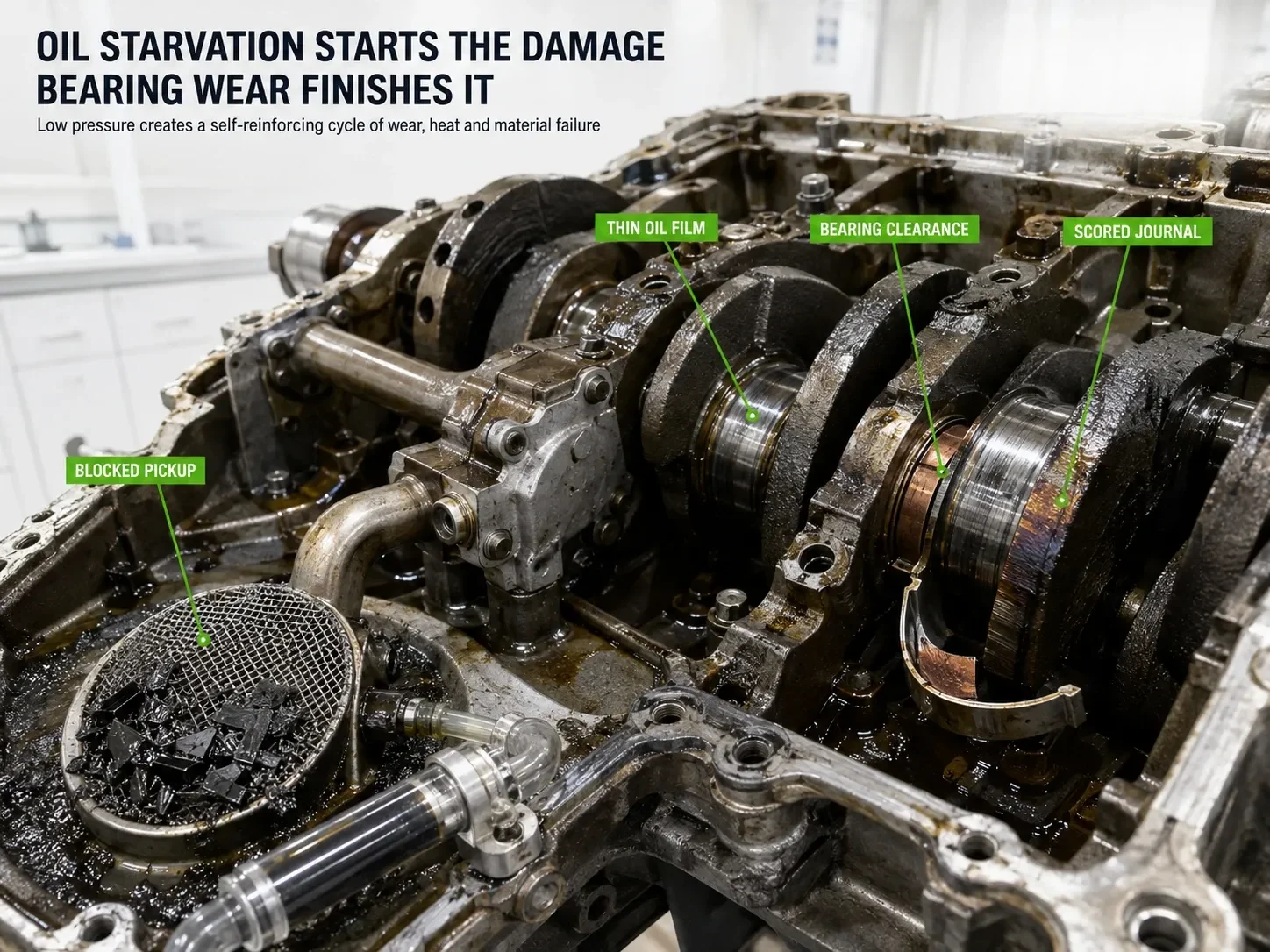
Crankshaft failure is a known 306DT issue. It usually starts with a bearing shell. If a main or big-end shell loses its oil film, it can turn in its housing, block its own oil feed and damage the crank journal.
The warning signs are a knock that rises with revs, an oil pressure light, or metal in the oil. Some engines give very little warning before they seize. If you hear a knock, stop. A spun bearing caught early can sometimes be repaired with a crank grind and new shells. One that has been driven on can damage the block too.
A 306DT engine rebuild means the crank is crack-tested and ground or replaced, every bearing is renewed, the oil pump and oil passages are checked, and the cause is found. While the engine is out we fit both timing belts. If the block is damaged, a reconditioned 306DT or a checked replacement engine is often the better route, and we explain why before any work starts.
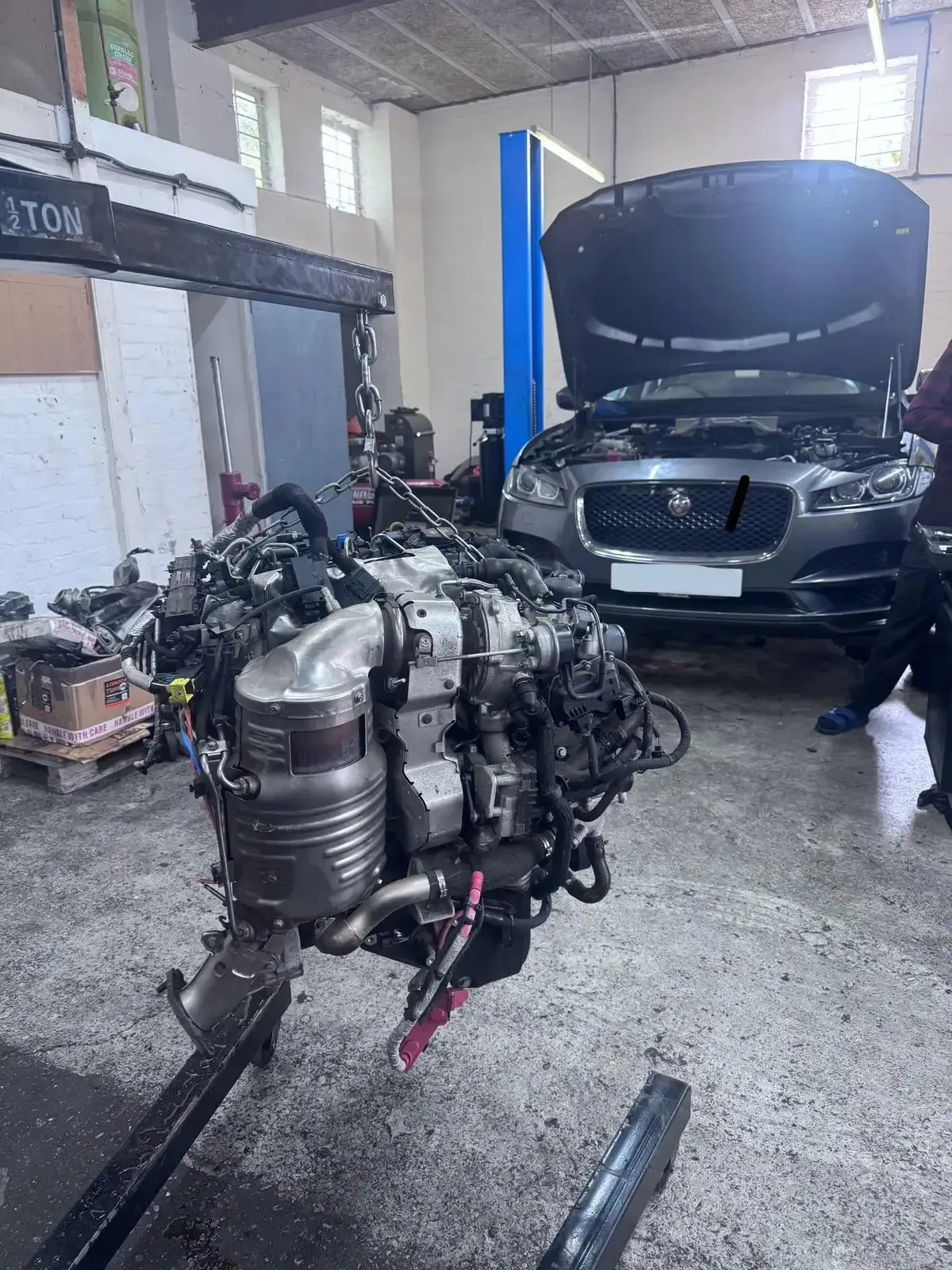
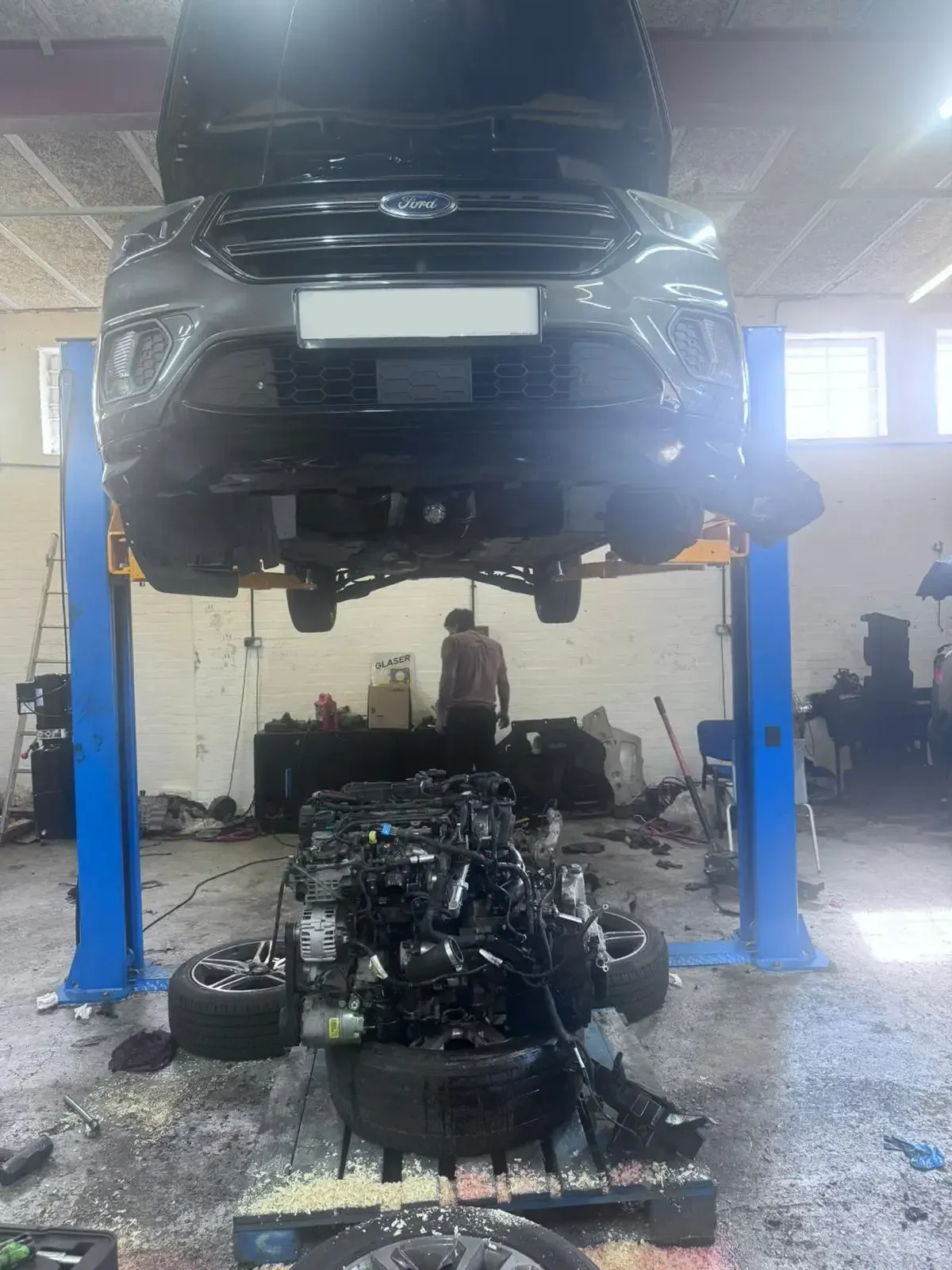
Engine out for crankshaft and bearing work at our partner workshop.
Warning signs
Warning signs on a 306DT engine
Knocking from low down that gets louder with revs
Oil pressure warning, even briefly
No proof of the last timing belt change, or the car is past 7 years
Squeal or rough running from cold that could point to a belt or tensioner
Blue smoke, a turbo whistle or sudden loss of power
White sweet-smelling smoke or coolant needing regular top-ups
DPF warnings, limp mode or a fan running after you park
Metal flakes in the oil at a service
Switch off if…
oil pressure or temperature warnings appear. A 306DT engine driven on can go from repairable to scrap.
Your options
Repair, rebuild, reconditioned or used: which is right for your 306DT engine?
For a 306DT, the timing kit is both toothed belts with their tensioners and idlers. Full parts scope: engine rebuild.
Diagnosis
Oil pressure and crank noise checked first.
Removal & strip-down
Belt condition and tensioners inspected.
Cleaning & crack testing
Crank and block checked for bearing damage.
Machining
Crank journals measured and ground or replaced.
New parts fitted
New bearings, oil pump checked, full belt kit.
Assembly & testing
Oil system primed before first start.
Refit, coding & road test
Turbo, EGR and DPF operation checked.
From your first call to handback, see how it works.
Compatibility
Can I fit a different V6 diesel to my car?
Sometimes, but it is rarely a straight swap. The 2.7 and 3.0 share a family, but not the crank, turbos, injection or calibration. Within the 306DT, outputs and emissions hardware vary by model and year.
Like for like: a 306DT for a 306DT of the same output and era is the simplest swap, with coding.
Across outputs: a TDV6 and an SDV6 share the block, but turbos, injectors and calibration differ.
2.7 to 3.0: not a practical swap. The wiring, ECU, turbos and fuel system are all different.
306DT to Ingenium six: not possible. The AJ20D6 is a different engine with a 48-volt system.
Whichever route you choose, the replacement unit is coded to the car with diagnostic equipment, and we confirm compatibility against your VIN first.
Oil & aftercare
How to protect a rebuilt 306DT engine
Use the oil grade and specification named in your handbook, and change it on time or sooner if most trips are short.
Keep proof of both timing belt changes. If there is none, treat them as due.
Never ignore an oil pressure light or a knock, even if it goes away.
Give the car regular longer runs so DPF regenerations can finish.
Watch the coolant level. An EGR cooler leak can overheat the engine.
Let the engine idle for a moment after hard driving or towing so the turbos can cool.
306DT engine rebuild cost
What affects the quote for a 306DT engine rebuild or replacement?
No fixed price: the 306DT engine quote depends on what we find.
The 306DT is the 3.0-litre V6 twin-turbo diesel from the Ford and PSA AJD-V6 / DT17 family. Land Rover sold it as the TDV6, SDV6 and Td6, and Jaguar as the 3.0d, 30d and D300. It has 2,993 cc, 24 valves and two-stage parallel-sequential turbos.
Is the SDV6 the same engine as the TDV6?
Yes. Both are the 306DT. The SDV6 badge was generally used for the higher-output versions and the TDV6 for the lower ones, with different turbo and calibration settings. We confirm the exact output from your VIN.
Is a 2010 TDV6 the same as a 2015 one?
It is the same 306DT family. 2010–2011 Land Rovers had the 245 PS version with a ZF six-speed; from the 2012 model year the 211 PS TDV6 and 256 PS SDV6 came with the ZF eight-speed. Replacement engines must match the year.
What are the known TDV6 engine problems?
The faults we see on the 3.0 TDV6 and SDV6 are crankshaft and bearing failure, timing belt and tensioner wear, EGR cooler leaks, turbo failure and DPF blockage. Several are linked to oil condition, so we check for all of them before quoting.
Can you repair a TDV6 / SDV6 crankshaft failure?
Yes. A main or big-end bearing shell can lose its oil film, turn in its housing and damage the crank. A knock that rises with revs or an oil pressure warning are the signs. Stop driving straight away, because a spun bearing caught early is more likely to be repairable. Our TDV6 and SDV6 crankshaft failure guide explains why it happens and how JLR revised the crank.
Does the 306DT have a timing belt or chain?
It has toothed belts. A belt at the front drives the camshafts and a second belt at the rear drives the high-pressure fuel pump. The interval is commonly quoted as 7 years or 112,000 miles, whichever comes first, but check your own handbook. Both belts should be changed together.
What are the 2.7 TDV6 engine problems?
The 2.7 TDV6 (276DT) is the older version of the same family, used in the Discovery 3, early Discovery 4 and Range Rover Sport L320. It shares the belt-driven layout and some of the same bottom-end and turbo concerns. Those cars are older than the models on this site, so call us to talk it through.
Should I rebuild or replace a failed TDV6 engine?
It depends on the damage. A spun bearing with a sound block is usually a rebuild. A cracked block or badly damaged crank may point to a reconditioned engine or a checked used unit. We diagnose first, then explain the recon engine options against a rebuild.
How much does a 306DT engine rebuild cost?
We don't publish a fixed price, because the work depends on the output, how much damage there is, whether the turbos or injectors are affected, and whether you choose a rebuild, a reconditioned unit or a used engine. Send your reg and the symptoms for a written quote.
What warranty do you give on a 306DT rebuild?
You choose between 6 months with unlimited miles or 12 months / 12,000 miles. Both options are explained on our warranty page and confirmed in writing with your quote.
Can you collect my car if the engine has failed?
Yes. We can arrange collection within about 100 miles of our Rainham and Peterborough workshops, including non-runners.